Slow Cooker Sunday Beef Stew with Red Wine and Root Vegetables
Fall-apart chuck roast braised low and slow with red wine, mushrooms, carrots, potatoes, and pearl onions in a rich, glossy gravy. The ultimate set-it-and-forget-it Sunday dinner.
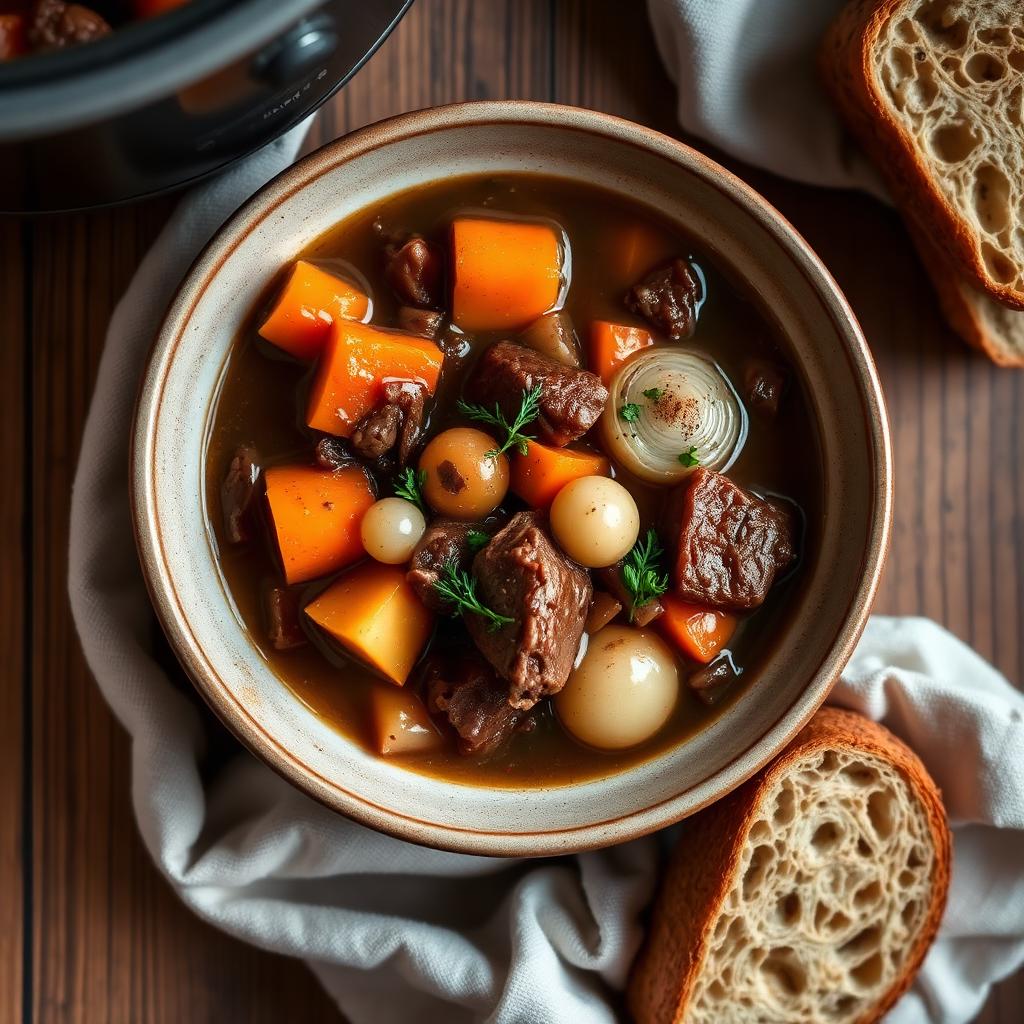
A truly great slow cooker beef stew is one of those magical dinners that smells like you have been cooking all day, takes about 25 minutes of actual hands-on work, and rewards you with a pot of fall-apart beef in a deeply savory, glossy gravy. This version skips the watery, vaguely beige stew of slow cooker disappointment and goes straight for restaurant-quality flavor — we sear the beef first, deglaze with red wine, and finish with a touch of butter and fresh herbs. The result is the kind of cold-weather Sunday dinner that you serve in big bowls with crusty bread and a glass of whatever wine you used in the pot.
I bought my first slow cooker at a thrift store in my early twenties for six dollars, mostly because I worked long shifts and the idea of coming home to a hot dinner felt borderline miraculous. The first few stews I attempted were not great. They were the watery, gray, vaguely flavorless versions that gave slow cookers a bad reputation in the 2000s — beef that had clearly been overcooked into shreds, vegetables that had dissolved into mush, and a broth that tasted like beef-flavored water.
The turning point came when a coworker who had grown up in a French-Canadian household watched me throw raw beef and cold liquid into the slow cooker one morning and gently informed me that I was committing a small culinary crime. The single most important thing about slow cooker stew, she told me, is to sear the beef first. Not lightly. Aggressively. You want a deep mahogany crust on every piece, and then you want to deglaze the searing pan with red wine and scrape up every brown bit before it goes into the slow cooker. That fond — the sticky, caramelized residue left in the pan — is where about ninety percent of the flavor lives.
The second thing she taught me was about the cut of beef. Chuck roast is what you want. Not stew meat from the grocery (often a mystery mix of cuts), not sirloin (too lean, dries out), not brisket (great in its own right, but a different texture). A well-marbled chuck roast, cut into two-inch chunks yourself, will fall into silky shreds after eight hours. The fat in the chuck slowly melts and bastes the meat from the inside out, which is exactly what you want for stew.
The third secret is to add the vegetables in the right order. Carrots, pearl onions, and potatoes can go in at the start — they actually need the full eight hours to get truly tender and to absorb the gravy. Mushrooms, on the other hand, should be sautéed separately and added in the last 30 minutes or they will overcook and lose their texture. And fresh herbs — thyme and rosemary — go in twice: a sturdy bunch at the start for slow infusion, and fresh leaves stirred in at the end for brightness.
The last detail is the gravy. A common slow cooker stew problem is that the liquid is too thin after eight hours because the slow cooker traps all the moisture instead of evaporating it. Twenty minutes before serving, I lift out the meat and vegetables with a slotted spoon, pour the liquid into a saucepan, simmer it hard for ten minutes, and finish with a knob of butter whisked in at the end. The result is a glossy, restaurant-quality gravy that coats every spoonful. Pour it back over the stew, scatter with fresh parsley, and you have a dinner that will make your house smell incredible all day and put smiles on every face at the table. We serve ours with thick slices of buttered sourdough for soaking up every last drop of gravy.
What you'll need
- 013 lbs chuck roast, trimmed and cut into 2-inch cubes
- 021 1/2 teaspoons kosher salt
- 031 teaspoon freshly ground black pepper
- 041/4 cup all-purpose flour
- 053 tablespoons olive oil, divided
- 061 large yellow onion, diced
- 074 garlic cloves, minced
- 083 tablespoons tomato paste
- 091 1/2 cups dry red wine (Cabernet Sauvignon, Merlot, or Côtes du Rhône)
- 103 cups low-sodium beef broth
- 112 tablespoons Worcestershire sauce
- 121 tablespoon balsamic vinegar
- 135 large carrots, cut into 1-inch pieces
- 141 1/2 lbs Yukon Gold potatoes, halved or quartered
- 151 cup frozen pearl onions, thawed
- 164 sprigs fresh thyme
- 172 sprigs fresh rosemary
- 182 bay leaves
- 198 oz cremini mushrooms, quartered
- 202 tablespoons unsalted butter
- 211/4 cup chopped fresh parsley
How to make it
- 1
Pat the beef cubes very dry with paper towels — dry meat is essential for a good sear. Season generously with salt and pepper, then toss with the flour to coat lightly.
- 2
Heat 2 tablespoons olive oil in a large skillet over medium-high heat. Working in batches to avoid crowding, sear the beef on all sides until deeply browned, about 2-3 minutes per side. Transfer to the slow cooker insert.
- 3
In the same skillet, add the remaining tablespoon of oil and the onion. Cook for 4-5 minutes until softened. Add the garlic and tomato paste and cook for another minute until the paste darkens.
- 4
Pour in the red wine and scrape up every brown bit from the bottom of the pan with a wooden spoon. Simmer for 2 minutes to cook off the harsh alcohol notes.
- 5
Pour the wine mixture into the slow cooker. Add the beef broth, Worcestershire, balsamic, carrots, potatoes, pearl onions, thyme sprigs, rosemary, and bay leaves.
- 6
Cover and cook on LOW for 8 hours or HIGH for 4-5 hours, until the beef is fall-apart tender.
- 7
About 30 minutes before serving, heat a dry skillet over medium-high heat. Add the mushrooms and cook without stirring for 3 minutes, then toss and cook another 3 minutes until golden. Stir into the stew.
- 8
For a glossy, restaurant-style gravy: use a slotted spoon to transfer the meat and vegetables to a serving bowl. Pour the liquid into a saucepan and simmer hard for 8-10 minutes until reduced by a third.
- 9
Whisk in the butter until glossy. Discard the herb stems and bay leaves. Pour the reduced gravy over the meat and vegetables.
- 10
Sprinkle generously with chopped parsley and serve in deep bowls with crusty bread.
Tips from the kitchen
- 01
Searing the beef in batches is critical — crowding causes steaming instead of browning and dramatically reduces flavor.
- 02
The flour coating helps both with browning and with naturally thickening the gravy.
- 03
If your slow cooker runs hot, the LOW setting may finish closer to 7 hours. Test the beef with a fork around the 7-hour mark.
- 04
Yukon Gold potatoes hold their shape better than russets, which can fall apart over 8 hours.
- 05
Always add mushrooms separately at the end — they get rubbery if cooked the full 8 hours.
- 06
Stew tastes even better the next day. Make ahead and reheat gently on the stove.
Frequently asked
Can I skip searing the beef?
You can, but the flavor will be noticeably less developed. Searing creates the deep brown crust that defines the entire stew.
What can I substitute for red wine?
Use an extra cup of beef broth plus an extra tablespoon of balsamic and Worcestershire to mimic the depth.
Can I cook this on the stovetop or in a Dutch oven instead?
Yes. After deglazing, transfer everything to a Dutch oven, cover, and braise at 325°F for 2.5-3 hours.
How do I store and reheat leftovers?
Refrigerate up to 4 days or freeze up to 3 months. Reheat gently on the stovetop with a splash of broth.
Can I add other vegetables?
Parsnips, turnips, celery root, and butternut squash all work beautifully in place of or in addition to the carrots and potatoes.